
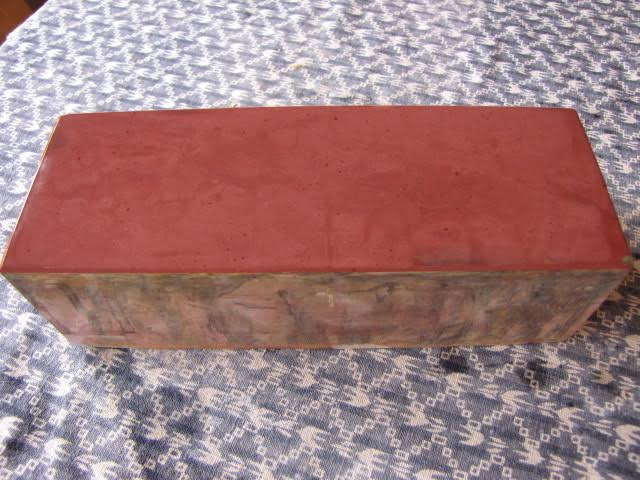
The Jokioji whetstone is a historic, natural „medium-hardness whetstone“ quarried in Fukui Prefecture. It is said to have been discovered by the Asakura clan in Ichijodani during the Sengoku period. This stone is used for the primary sharpening stage and belongs to the highly regarded Akado (red whetstones) line.
It is typically used after coarse and Bisui honing stones. Among these, high-quality Akado is considered the best Jōkōji grade and is regarded by polishers as a top-quality product.
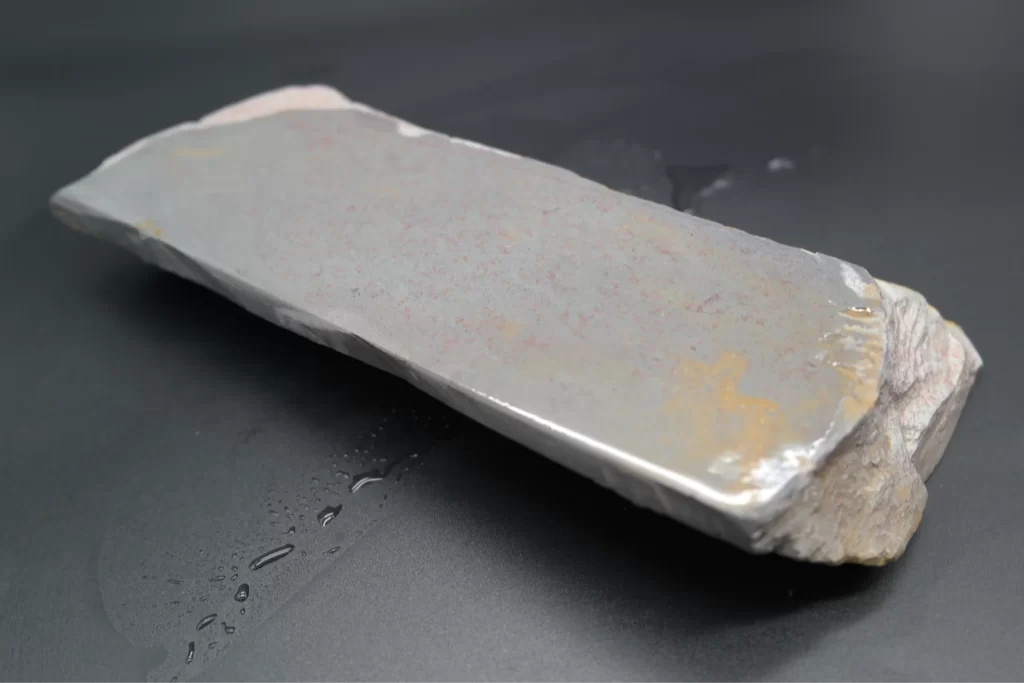
Jōkyōji (Jokioji), a natural Japanese whetstone, was used as the basis for preparing steel and defining its shape and lines even before the widespread use of Uchigumori. First and foremost, Akado is characterized by uniform abrasive grains, does not over-polish, and pairs perfectly with Uchigumori, which is why it is considered a whetstone highly valued by skilled sword and knife polishers. Since stones are selected based on „workmanship“ rather than color, many high-quality stones found in the base layer have a reddish tint; therefore, Akato (red sharpening stone) is synonymous with the highest-quality Jōkyōji sharpening stones.
Role in Intensive Polishing. The Jōkyōji sharpening stone (Akato) is an extremely important element that plays a decisive role in the final stage of primary polishing. It refines and evens out the polishing marks left by the coarse and Bisui stones. This determines the final appearance of the shinogi-suji, habaki, and kissaki yokote lines. The Jōkyōji brings out the jigane and prepares the steel so that the uchigumori stone can work on it effectively.
A reddish-brown or dark reddish-purple layer rich in iron. Fine abrasive grains that are not too sharp and are durable. Excellent water retention, allowing the sharpener to operate stably. Does not grind, but rather highlights and shapes the appearance of the steel – It features the hardness and grip characteristic of natural whetstones, which cannot be achieved using modern artificial or semi-natural whetstones.
Rarity and difficulty in acquisition. The Jōkyōji quarry is now practically depleted, and the extraction of new whetstones is considered nearly impossible. High-quality red whetstones appear on the market very rarely because they are sought after by collectors of whetstone collections, are often old stock or remnants, and stones in good condition and of high quality are extremely rare. In fact, owners rarely part with them, and they are sometimes treated as assets rather than tools.“.
Since this is a natural sharpening stone, layering, color variations, and minor scratches are to be expected—it is not a substitute for hybrid or artificial sharpeners. This stone is intended for those who appreciate the art of sharpening swords and knives and gentle polishing.
 LT
LT EN
EN ES
ES FR
FR DE
DE IT
IT RU
RU PL
PL PT
PT RO
RO NL
NL